


 Local Movers
 Last-Minute Movers
 Junk Removal
 Long Distance Movers
 Piano Movers
 Heavy Equipment
 Commercial Movers
 Moving Container
 Car Transportation
 Furniture Movers
 Truck Rental
 Moving Cost Calculator
 Moving Planner
 Packing Calculator
 Moving Checklist
 Moving Insurance
 FAQ
FAQ Contact Us
 Moving Loan
 Privacy Policy
 Join Our Network
 About Us
Hand Truck vs Dolly: Which One Is Better for Moving and Heavy Lifting?


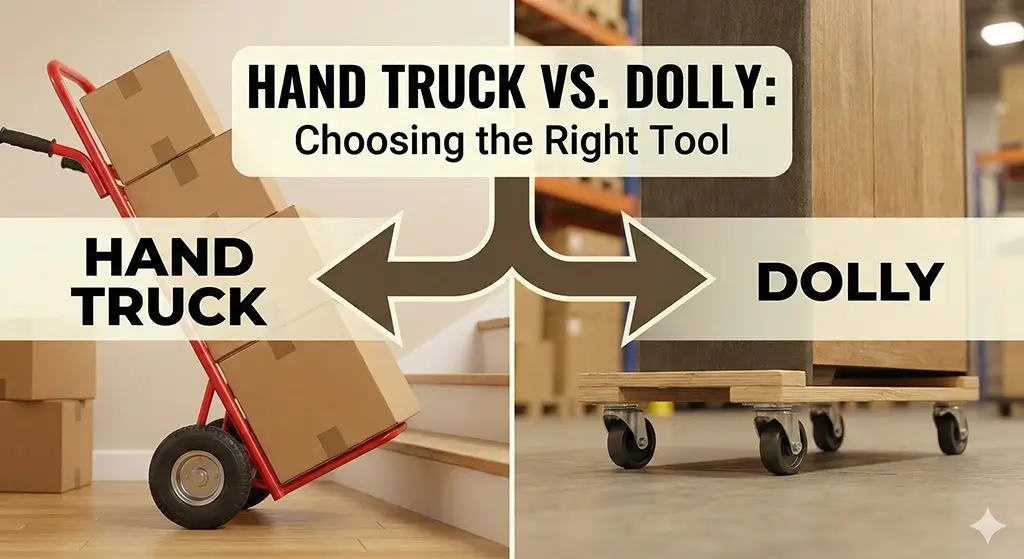
Moving heavy items—whether during a house relocation, office move, warehouse operation, or simple home rearrangement—can be physically demanding and risky without the right equipment. Two of the most commonly used tools for lifting and transporting heavy items are hand trucks and dollies. While many people use these terms interchangeably, they are not the same, and choosing the wrong one can lead to inefficiency, damage, or even injury.
In this in-depth guide, we’ll break down the differences between a hand truck vs dolly, explore their uses, pros and cons, weight capacities, and help you decide which one is best for your specific moving needs. Whether you’re a DIY mover or hiring professionals, understanding this difference can make your move safer and smoother.
What Is a Hand Truck?
A hand truck (also called a two-wheel dolly or upright dolly) is a vertical, L-shaped tool designed to move heavy items in an upright position. It consists of a tall frame, two wheels at the bottom, and a flat ledge (toe plate) that slides under objects.
Hand trucks are commonly used to move appliances, boxes, refrigerators, washing machines, and stacked loads. The leverage created by tilting the load backward makes it easier to transport heavy items with less physical strain.
Key Features of a Hand Truck
Hand trucks are designed with stability and vertical transport in mind. Most models include tall handles, durable wheels, and a strong frame that supports heavy loads.
Some advanced hand trucks also feature stair-climbing wheels, adjustable frames, and straps to secure items during transport. These features make hand trucks a go-to choice for professional movers and warehouse workers.
Common Uses of a Hand Truck
Hand trucks are ideal for moving items that are tall, heavy, and stackable. They are widely used in residential moves, grocery stores, warehouses, and delivery services.
Typical use cases include moving refrigerators, bookcases, stacked boxes, filing cabinets, and vending machines. Because they keep items upright, they are perfect for objects that should not be laid flat.
What Is a Dolly?
A dolly is a flat platform with four wheels, designed to move heavy items horizontally. Unlike hand trucks, dollies do not have a vertical frame or handles. Items are placed directly on top of the platform and rolled across flat surfaces.
Dollies are commonly used to move furniture, large boxes, safes, and heavy equipment over short distances, especially indoors.
Key Features of a Dolly
Dollies typically feature a square or rectangular platform made of wood, plastic, or metal, supported by four swivel or fixed caster wheels. Some dollies include padded surfaces or raised edges to prevent slipping.
Because they lack handles, dollies rely on pushing or pulling force, making them best suited for level surfaces like hardwood floors, concrete, or tile.
Common Uses of a Dolly
Dollies are perfect for moving wide, bulky, or awkwardly shaped items that cannot easily be tilted upright. Furniture like couches, dressers, coffee tables, and heavy boxes are ideal candidates.
They are also frequently used in offices, event setups, retail stores, and moving trucks for internal repositioning of items.
Hand Truck vs Dolly: Core Differences
Although both tools serve similar purposes, they are designed for very different applications. Understanding these differences helps prevent misuse and accidents.
A hand truck supports vertical lifting and leverage, while a dolly supports horizontal rolling. Choosing between them depends on item shape, weight, distance, and surface type.
Difference #1: Design and Structure
A hand truck has a vertical frame with two wheels and a toe plate, allowing items to be tilted and rolled. This design minimizes lifting strain by using leverage.
A dolly, on the other hand, is a flat platform with four wheels and no frame. Items sit directly on the base, requiring manual pushing or pulling.
Difference #2: Load Orientation
Hand trucks transport items in an upright position, which is ideal for tall or stackable objects like appliances and boxes.
Dollies transport items in a horizontal position, making them better for wide or unstable furniture that could tip if stood upright.
Difference #3: Weight Distribution
Hand trucks distribute weight through leverage and wheel balance, allowing users to move heavy loads with less effort.
Dollies distribute weight evenly across the platform, requiring more pushing force but offering greater stability on flat surfaces.
Difference #4: Terrain and Surface Compatibility
Hand trucks work well on uneven surfaces, ramps, thresholds, and stairs (with proper models).
Dollies perform best on smooth, flat surfaces and are not suitable for stairs or rough terrain.
Weight Capacity Comparison
Weight capacity varies depending on the model, materials, and wheel type.
Hand trucks typically support 600–1,200 lbs, while heavy-duty commercial models can handle even more. Dollies usually support 800–1,500 lbs, depending on size and construction.
Hand Truck Pros and Cons
Advantages of Using a Hand Truck
Hand trucks reduce physical strain by leveraging weight rather than lifting it entirely. They are excellent for vertical movement and navigating tight spaces.
They are also highly versatile, working well on stairs, curbs, and uneven surfaces when equipped with the right wheels.
Disadvantages of Using a Hand Truck
Hand trucks require proper technique to avoid tipping or imbalance. They are not ideal for wide or low-profile furniture.
Improper use can result in damage to fragile items or injury if loads are not secured.
Dolly Pros and Cons
Advantages of Using a Dolly
Dollies provide excellent stability for large and bulky items. They are easy to use and require minimal training.
They are perfect for indoor moves, furniture rearrangement, and moving items across flat surfaces.
Disadvantages of Using a Dolly
Dollies cannot handle stairs or uneven terrain. They also require lifting items onto the platform, which can be physically demanding.
Without straps, items may shift or slide during movement.
Hand Truck vs Dolly for Moving Appliances
When moving appliances like refrigerators, washers, or dryers, hand trucks are the preferred choice. Appliances are tall, heavy, and designed to stay upright.
Using a dolly for appliances increases the risk of tipping, internal damage, or compressor issues.
Hand Truck vs Dolly for Furniture
For furniture like sofas, dressers, and tables, dollies often work better. These items are wide and awkward to balance vertically.
Furniture dollies allow movers to slide items safely without tilting or risking scratches.
Hand Truck vs Dolly for Boxes
Both tools work for boxes, but the choice depends on volume. Hand trucks are ideal for stacked boxes, while dollies are better for moving multiple large boxes at once.
Professional movers often use both tools together during a move.
Safety Considerations When Using a Hand Truck
Always secure items with straps before tilting. Keep your back straight and use leg strength when maneuvering.
Never overload the hand truck beyond its rated capacity, and avoid sudden movements that could destabilize the load.
Safety Considerations When Using a Dolly
Lift with proper posture when placing items on the dolly. Ensure wheels roll smoothly and lock if available.
Avoid slopes or ramps unless the dolly is designed for incline use.
Which Is Better for DIY Moving?
For DIY movers, having both a hand truck and a dolly provides maximum flexibility. Each tool serves a unique purpose.
If you must choose one, select based on what you’re moving most—appliances and boxes favor hand trucks, while furniture favors dollies.
What Do Professional Movers Use?
Professional moving companies use both tools strategically. They assess item type, layout, and distance before choosing equipment.
Companies like VanLinesMove work with trained movers who know exactly when to use a hand truck versus a dolly, ensuring safety and efficiency.
Cost Comparison: Hand Truck vs Dolly
Hand trucks generally cost between $60–$150, while dollies range from $40–$120 depending on quality.
Rental costs are usually minimal, and many moving companies include them as part of their service.
Do You Need Both for a Move?
For most household moves, the answer is yes. Using both tools speeds up the process and reduces physical strain.
Having the right tool for the right item prevents damage and improves overall efficiency.
Hand Truck vs Dolly: Final Verdict
There is no universal winner—it depends on the task. Hand trucks excel at vertical lifting and stairs, while dollies dominate flat, wide loads.
Understanding the strengths of each tool helps you move smarter, safer, and faster.
How VanLinesMove Helps You Move Smarter
VanLinesMove connects you with professional movers who arrive fully equipped with hand trucks, dollies, straps, and specialty tools. You don’t have to worry about choosing the wrong equipment or risking injury.
Whether you’re moving locally or long-distance, VanLinesMove ensures every item is handled with the right tool and expert care.
Conclusion
Choosing between a hand truck and a dolly can significantly impact the success of your move. While both tools are essential, they serve different purposes and work best when used correctly.
For a stress-free move without guesswork, trust professionals who understand equipment, logistics, and safety from start to finish.
FAQs: Hand Truck vs Dolly
1. What is the main difference between a hand truck and a dolly?
A hand truck is a vertical, two-wheel tool designed to move items upright using leverage, while a dolly is a flat platform with four wheels used to roll items horizontally across flat surfaces.
2. Is a hand truck better than a dolly for moving appliances?
Yes. Hand trucks are ideal for appliances like refrigerators and washing machines because they keep items upright and provide better balance and control during transport.
3. Can a dolly be used to move furniture?
Yes. Dollies are excellent for moving furniture such as couches, dressers, and tables, especially on smooth floors, because they offer stability for wide or bulky items.
4. Which tool is safer for DIY moving?
Both are safe when used correctly. Hand trucks are safer for tall items, while dollies are safer for wide furniture. Many DIY movers benefit from using both tools together.
5. Do professional movers use both hand trucks and dollies?
Yes. Professional movers routinely use both tools depending on the item type, distance, and surface conditions to ensure efficiency and safety.
6. How much weight can a hand truck or dolly handle?
Hand trucks typically support 600–1,200 lbs, while dollies can handle 800–1,500 lbs depending on the model and construction.
7. Do moving companies provide these tools?
Yes. Companies like VanLinesMove ensure movers arrive with the proper equipment, including hand trucks, dollies, straps, and padding.
Categories
- Long Distance Moving159
- Local Moving120
- Commercial Moving40
- Residential Moving34
- Last – Minute Moving25
- Furniture Moving11
- Moving Tips & Lifestyle11
- Moving Tips & How-To Guides8
- Moving services7
- Moving Costs & Budgeting6
- Moving Cost5
- Moving Cost Calculator5
- Moving Tips5
- Moving Guides5
- moving tips4
- Moving companies4
- state to state movers4
- Piano Moving3
- Car Transportation3
- Truck Rental3
- Moving Container3
- Local Move3
- best moving rates3
- cheap moving companies3
- affordable moving companies3
- full-service movers3
- Moving3
- Long distance moving3
- Long-Distance Moving3
- Moving Cost Guides3
- Moving Tips & Planning3
- long distance moving3
- Junk Removal2
- Senior Moving2
- Senior Relocation Moving Companies2
- Moving Tools2
- Moving Estimates2
- interstate moving2
- College Moving2
- Dorm Moving2
- Tips for moving2
- cross-country move2
- International moving2
- Household moving2
- Relocation Guide2
- Moving Tips & State Guides2
- Heavy Equipment1
- Senior Moving Services1
- office moving1
- office relocation1
- employee relocation1
- Car Transport1
- Vehicle Shipping1
- Car Shipping Services1
- Artificial Intelligence1
- Office Moving Services1
- Commercial Moving Companies1
- Corporate Moving Services1
- Corporate Movers1
- full-service moving companies1
- sustainable moving companies1
- green movers1
- Moving in US1
- Best places to move in 20251
- 2025 moving1
- Full-Service Moving Companies1
- College moving services1
- Moving to College1
- Moving Season1
- Spring Moving1
- donate1
- sell1
- Movers in California1
- Movers in Studio City1
- Moving to California1
- Laws about Moving into California1
- Moving Laws1
- House moving1
- packing1
- cheap moving ways1
- Moving guide1
- moving across countries1
- international relocation program1
- move out cleaning1
- right packing supplies1
- pack while moving1
- Apartment moving1
- PODS1
- moving out1
- state to state move1
- California movers1
- Truck Rental1
- US Territory Relocation1
- International Moving1
- Shipping & Moving Tips1
- Moving Budget Guide1
- Moving Tools & Equipment Guides1
- Moving Services & Options1
- Moving Tips & How-To Guides1
- Moving Day & Settling In1
- Mobile Home Moving1
- Moving Guide & Tips1
- Moving Tips & State Comparisons1
- Moving Tips & City Guides1
- Moving Tips & Cost Guides1
- Long-Distance Moving Tips1
- Moving Tips & Financial Planning1
- Moving Tips & Home Preparation1
- Vehicle Shipping & Auto Transport1
- Marketing & Lead Generation1
- International Moving Guides1
- Moving Costs1
- San Francisco Moving Guide1
- NYC Moving1
- Local Movers1
- Budget Moving1
- Student Moving1
- Affordable Moving1
- Specialty Moving Guides1
- Local & Long-Distance Moving1
- Boston Moving Guide1
- Europe Relocation Guide1
- Moving Costs & Specialty Moving1
- Cost of Living1
- Relocation1
- International Moving1
- Lifestyle & Relocation1
- State Guides1
- Home Buying Guide1
- Moving Timeline1
- Real Estate Tips1
- Appliance Moving1
- Packing & Preparation1
- Interstate Relocation1
- City-to-City Moving Guide1
- Technology for Movers1
- Moving Reviews1
- Moving Costs & Storage1
- Moving Tips & Equipment Guides1
- Moving Guides & Cost Insights1
- Moving Supplies1
- Packing Tips1
- Home Moving1
- Relocation Tips1
- State Moving Guides1
- New Home Guide1
- Relocation Advice1



 Chat with us on WhatsApp!


 BBB A+ Rated
 Great! We serve your area
 Licensed & Insured
 Takes 60 seconds

 Discount expires in
 Limited Time: Only 3 premium movers available in your area


 Your information is 100% secure