


 Local Movers
 Last-Minute Movers
 Junk Removal
 Long Distance Movers
 Piano Movers
 Heavy Equipment
 Commercial Movers
 Moving Container
 Car Transportation
 Furniture Movers
 Truck Rental
 Moving Cost Calculator
 Moving Planner
 Packing Calculator
 Moving Checklist
 Moving Insurance
 FAQ
FAQ Contact Us
 Moving Loan
 Privacy Policy
 Join Our Network
 About Us
Is Moving Insurance Worth It? A Complete Guide to Protecting Your Belongings


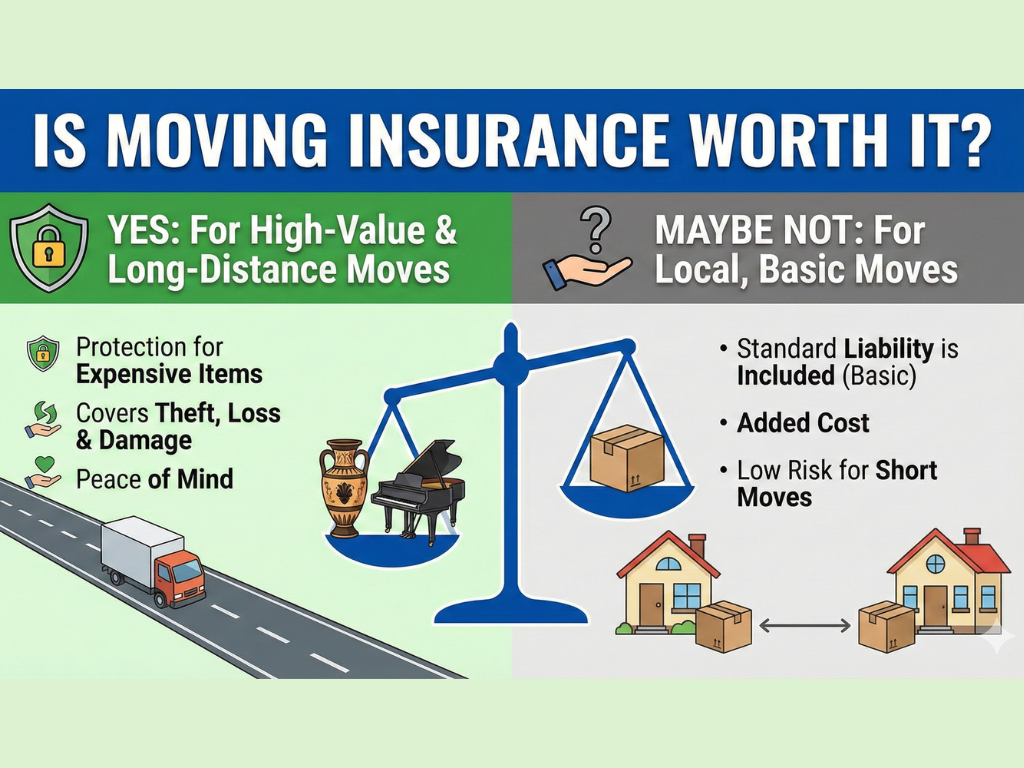
Moving is one of life’s biggest transitions, but it also exposes your belongings to unexpected risks. From packing accidents to transportation damage, even well-planned relocations can result in costly losses. Because of this, many homeowners wonder whether moving insurance is truly necessary or simply an optional extra.
The reality is that most moving companies provide only minimal liability protection, which may not reflect the true value of your possessions. Understanding how moving insurance works can help you avoid financial surprises and move with greater confidence. This guide explores coverage types, costs, benefits, drawbacks, and how to decide if insurance is worth it for your situation.
Understanding Moving Insurance
What Moving Insurance Really Means
Moving insurance is designed to financially protect your belongings if they are lost, damaged, or stolen during relocation. It provides reimbursement based on repair cost, replacement value, or declared shipment value depending on the policy you choose. Unlike basic mover liability, insurance focuses on the actual value of your possessions rather than their weight. This makes it especially important for households with expensive electronics, furniture, or fragile items.
Why Movers Don’t Provide Full Insurance by Default
Most moving companies offer valuation coverage instead of true insurance because they are transportation providers, not insurance companies. Valuation coverage defines the mover’s financial responsibility but may not fully compensate for damage. As a result, customers often need third-party insurance to achieve comprehensive protection. Understanding this difference helps avoid confusion when reviewing moving contracts.
Common Risks During a Move
Handling and Packing Mistakes
Packing errors and handling accidents are among the most common causes of damage during relocation. Fragile items can break due to improper cushioning, while heavy furniture may suffer scratches or dents during loading. Even experienced movers face challenges when navigating tight staircases, elevators, or narrow hallways. These risks highlight why financial protection can be valuable.
Transportation and Road Hazards
Long-distance moves expose shipments to road conditions, weather changes, and vehicle accidents. Sudden braking, uneven roads, or extreme temperatures can impact sensitive belongings like electronics and glassware. Additionally, extended transit time increases exposure to potential risks compared to local moves. Insurance helps protect against these unpredictable circumstances.
Moving Insurance vs Valuation Coverage
Released Value Protection Explained
Released value protection is the most basic coverage offered by movers and is typically included at no extra cost. However, compensation is calculated based on item weight rather than actual value, often around $0.60 per pound. This means lightweight but expensive items may receive minimal reimbursement. While useful for low-value moves, it provides limited financial protection.
Full Value Protection Overview
Full value protection offers significantly stronger coverage by requiring movers to repair, replace, or compensate for damaged items based on market value. This coverage increases moving costs but provides realistic reimbursement compared to basic liability. Many homeowners consider it a balanced option between affordability and protection. It is especially useful for medium to high-value relocations.
Third-Party Insurance Advantages
Third-party moving insurance provides the most comprehensive protection because it is independent of the mover’s liability limits. Policies may cover theft, natural disasters, and owner-packed boxes that movers might exclude. This option is ideal for high-value shipments or long-distance relocations where risks are greater. It also provides additional peace of mind for customers transporting irreplaceable items.
What Moving Insurance Covers?
Damage and Loss Protection
Most moving insurance policies cover physical damage caused by handling accidents, collisions, or loading errors. This ensures that broken furniture, damaged electronics, or lost boxes can be repaired or replaced without major financial burden. Comprehensive policies may even include coverage for total shipment loss. Understanding these protections helps evaluate whether coverage is worthwhile.
Theft and Catastrophic Events
Some insurance plans extend protection to theft, fire, and severe accidents during transit or storage. These scenarios are rare but can result in significant financial loss if they occur. Having insurance ensures that such unexpected events do not create overwhelming replacement costs. This additional security is a major reason many homeowners choose insurance.
What Moving Insurance Does Not Cover?
Owner-Packed Box Limitations
Many valuation plans exclude damage to boxes packed by the owner unless visible external damage is present. This creates potential claim challenges if fragile items were packed incorrectly. Professional packing services often improve coverage eligibility and claim approval chances. Understanding these limitations helps prevent claim disputes.
Restricted and High-Value Items
Certain items such as cash, documents, jewelry, and perishable goods are typically excluded from coverage. Additionally, natural disasters may not be covered under basic plans without supplemental insurance. Customers should carefully review policy exclusions before purchase. This ensures expectations align with actual protection.
Cost of Moving Insurance
Factors That Influence Pricing
Moving insurance costs depend on shipment value, coverage type, deductible amount, and move distance. Full value protection often costs around 1% of the declared value, while third-party policies vary based on risk assessment. Larger shipments naturally increase premiums due to higher potential loss. Evaluating these factors helps determine budget impact.
Is the Cost Justified?
Although insurance increases upfront moving expenses, it can prevent significantly higher replacement costs later. For households with valuable possessions, the cost is often considered a worthwhile investment. Even moderate coverage can provide peace of mind during stressful relocations. Comparing risk versus cost helps make a rational decision.
When Moving Insurance Is Worth It?
High-Value or Fragile Moves
Insurance is highly recommended when transporting expensive electronics, antiques, artwork, or sentimental items. Damage to such belongings can be financially and emotionally difficult to recover from. Comprehensive coverage ensures realistic compensation in case of accidents. This makes insurance particularly valuable for premium households.
Long-Distance and International Relocations
Longer transit distances increase exposure to handling, transportation, and storage risks. International moves involve customs handling and multiple carriers, further raising uncertainty. Insurance helps protect against complex logistical risks that are harder to control. For these moves, coverage is often strongly advised.
When You Might Skip Moving Insurance?
Small Local Moves
For short-distance moves involving inexpensive items, the risk of major financial loss may be minimal. Basic valuation coverage might provide sufficient protection in such cases. Budget considerations may also make insurance less appealing. However, even local moves can involve unexpected damage.
Existing Home Insurance Coverage
Some homeowners or renters insurance policies include limited transit protection. Reviewing your policy may reveal overlapping coverage that reduces the need for additional insurance. Understanding existing protection helps avoid unnecessary expenses. However, policy limits should always be verified.
Pros of Moving Insurance
Financial Protection and Peace of Mind
Insurance reduces stress by ensuring that unexpected damage does not result in significant financial loss. This allows homeowners to focus on settling into their new space instead of worrying about potential mishaps. The psychological benefit of peace of mind is often overlooked but extremely valuable. It contributes to a smoother relocation experience.
Realistic Compensation Compared to Basic Coverage
Unlike released value protection, insurance provides reimbursement based on actual item value. This ensures expensive belongings are adequately protected during transit. For many households, this difference alone justifies purchasing coverage. Realistic compensation prevents financial disappointment during claims.
Cons of Moving Insurance
Additional Moving Expense
The primary disadvantage is increased moving cost, which may strain tight budgets. Some homeowners may feel the added expense is unnecessary for low-value shipments. Evaluating risk tolerance is essential before making a decision. However, the cost is often small compared to potential loss.
Deductibles and Claim Complexity
Insurance policies may include deductibles and documentation requirements for claims. Filing claims can take time and require inventory records or photographs. These factors may discourage some customers from purchasing coverage. Understanding claim procedures beforehand helps reduce frustration.
How to Decide If Moving Insurance Is Right for You?
Evaluate Your Belongings’ Value
Start by estimating the replacement cost of your possessions and identifying high-value items. This helps determine potential financial exposure if damage occurs. A detailed inventory also simplifies claims if insurance is purchased. Knowing your shipment value is the foundation of an informed decision.
Compare Coverage Options
Review mover valuation plans alongside third-party insurance policies to understand differences in protection. Comparing deductibles, exclusions, and claim processes helps identify the most suitable option. Customers should prioritize transparency and realistic compensation. This ensures balanced protection and affordability.
How to Reduce Risk Even With Insurance?
Professional Packing and Documentation
Professional packing significantly reduces damage risk while improving insurance claim eligibility. Additionally, photographing items before moving provides valuable documentation if claims arise. Detailed labeling and inventory lists also simplify tracking and unpacking. Preventive steps complement insurance protection effectively.
Choosing Experienced Movers
Selecting reputable movers with proper equipment and trained staff reduces handling risks. Experienced crews understand packing techniques, loading balance, and protective wrapping methods. This decreases the likelihood of needing to file insurance claims. Combining professional service with coverage creates maximum protection.
How Platforms Like VanLinesMove Help?
Planning a move involves comparing multiple movers, understanding coverage options, and managing budgets effectively. Platforms like VanLinesMove.com simplify this process by connecting customers with verified carriers and helping them compare quotes and protection options. This transparency allows customers to evaluate both service quality and insurance availability before booking.
By offering access to multiple moving providers, VanLinesMove helps customers make informed decisions that balance affordability, reliability, and shipment protection. This reduces uncertainty while improving the overall moving experience.
Conclusion
Moving insurance is not mandatory, but it can be an essential safeguard depending on your situation. For high-value belongings, long-distance relocations, and risk-averse homeowners, the financial protection and peace of mind often justify the cost. While basic valuation coverage offers minimal reimbursement, comprehensive insurance ensures realistic compensation for unexpected damage.
Ultimately, the decision comes down to risk tolerance, shipment value, and existing coverage. Combining careful planning, professional movers, and appropriate insurance provides the safest path to a stress-free relocation.
FAQs
1. Is moving insurance necessary for local moves?
It depends on the value of your belongings. For low-value local moves, basic coverage may be sufficient, but insurance still provides added peace of mind.
2. Does moving insurance cover items packed by me?
Some policies do, but many valuation plans exclude owner-packed boxes unless external damage is visible.
3. How much does moving insurance cost?
Costs typically range around 1% of shipment value for full coverage, though third-party policies may vary.
4. Can I rely on homeowners insurance instead?
Some homeowners policies provide limited moving coverage, but transit protection is often restricted.
5. What is the best type of moving protection?
Full value protection or third-party insurance usually offers the most realistic financial coverage.
Categories
- Long Distance Moving159
- Local Moving120
- Commercial Moving40
- Residential Moving34
- Last – Minute Moving25
- Furniture Moving11
- Moving Tips & Lifestyle11
- Moving Tips & How-To Guides8
- Moving services7
- Moving Costs & Budgeting6
- Moving Cost5
- Moving Cost Calculator5
- Moving Tips5
- Moving Guides5
- Moving Container4
- moving tips4
- Moving companies4
- state to state movers4
- Piano Moving3
- Car Transportation3
- Truck Rental3
- Local Move3
- best moving rates3
- cheap moving companies3
- affordable moving companies3
- full-service movers3
- Moving3
- Long distance moving3
- Long-Distance Moving3
- Moving Cost Guides3
- Moving Tips & Planning3
- long distance moving3
- Junk Removal2
- Senior Moving2
- Senior Relocation Moving Companies2
- Moving Tools2
- Moving Estimates2
- interstate moving2
- College Moving2
- Dorm Moving2
- Tips for moving2
- cross-country move2
- International moving2
- Household moving2
- Relocation Guide2
- Moving Tips & State Guides2
- Heavy Equipment1
- Senior Moving Services1
- office moving1
- office relocation1
- employee relocation1
- Car Transport1
- Vehicle Shipping1
- Car Shipping Services1
- Artificial Intelligence1
- Office Moving Services1
- Commercial Moving Companies1
- Corporate Moving Services1
- Corporate Movers1
- full-service moving companies1
- sustainable moving companies1
- green movers1
- Moving in US1
- Best places to move in 20251
- 2025 moving1
- Full-Service Moving Companies1
- College moving services1
- Moving to College1
- Moving Season1
- Spring Moving1
- donate1
- sell1
- Movers in California1
- Movers in Studio City1
- Moving to California1
- Laws about Moving into California1
- Moving Laws1
- House moving1
- packing1
- cheap moving ways1
- Moving guide1
- moving across countries1
- international relocation program1
- move out cleaning1
- right packing supplies1
- pack while moving1
- Apartment moving1
- PODS1
- moving out1
- state to state move1
- California movers1
- Truck Rental1
- US Territory Relocation1
- International Moving1
- Shipping & Moving Tips1
- Moving Budget Guide1
- Moving Tools & Equipment Guides1
- Moving Services & Options1
- Moving Tips & How-To Guides1
- Moving Day & Settling In1
- Mobile Home Moving1
- Moving Guide & Tips1
- Moving Tips & State Comparisons1
- Moving Tips & City Guides1
- Moving Tips & Cost Guides1
- Long-Distance Moving Tips1
- Moving Tips & Financial Planning1
- Moving Tips & Home Preparation1
- Vehicle Shipping & Auto Transport1
- Marketing & Lead Generation1
- International Moving Guides1
- Moving Costs1
- San Francisco Moving Guide1
- NYC Moving1
- Local Movers1
- Budget Moving1
- Student Moving1
- Affordable Moving1
- Specialty Moving Guides1
- Local & Long-Distance Moving1
- Boston Moving Guide1
- Europe Relocation Guide1
- Moving Costs & Specialty Moving1
- Cost of Living1
- Relocation1
- International Moving1
- Lifestyle & Relocation1
- State Guides1
- Home Buying Guide1
- Moving Timeline1
- Real Estate Tips1
- Appliance Moving1
- Packing & Preparation1
- Interstate Relocation1
- City-to-City Moving Guide1
- Technology for Movers1
- Moving Reviews1
- Moving Costs & Storage1
- Moving Tips & Equipment Guides1
- Moving Guides & Cost Insights1
- Moving Supplies1
- Packing Tips1
- Home Moving1
- Relocation Tips1
- State Moving Guides1
- New Home Guide1
- Relocation Advice1


 Chat with us on WhatsApp!


 BBB A+ Rated
 Great! We serve your area
 Licensed & Insured
 Takes 60 seconds

 Discount expires in
 Limited Time: Only 3 premium movers available in your area


 Your information is 100% secure