


 Local Movers
 Last-Minute Movers
 Junk Removal
 Long Distance Movers
 Piano Movers
 Heavy Equipment
 Commercial Movers
 Moving Container
 Car Transportation
 Furniture Movers
 Truck Rental
 Moving Cost Calculator
 Moving Planner
 Packing Calculator
 Moving Checklist
 Moving Insurance
 FAQ
FAQ Contact Us
 Moving Loan
 Privacy Policy
 Join Our Network
 About Us
Non-Binding Moving Estimate: What You Need to Know


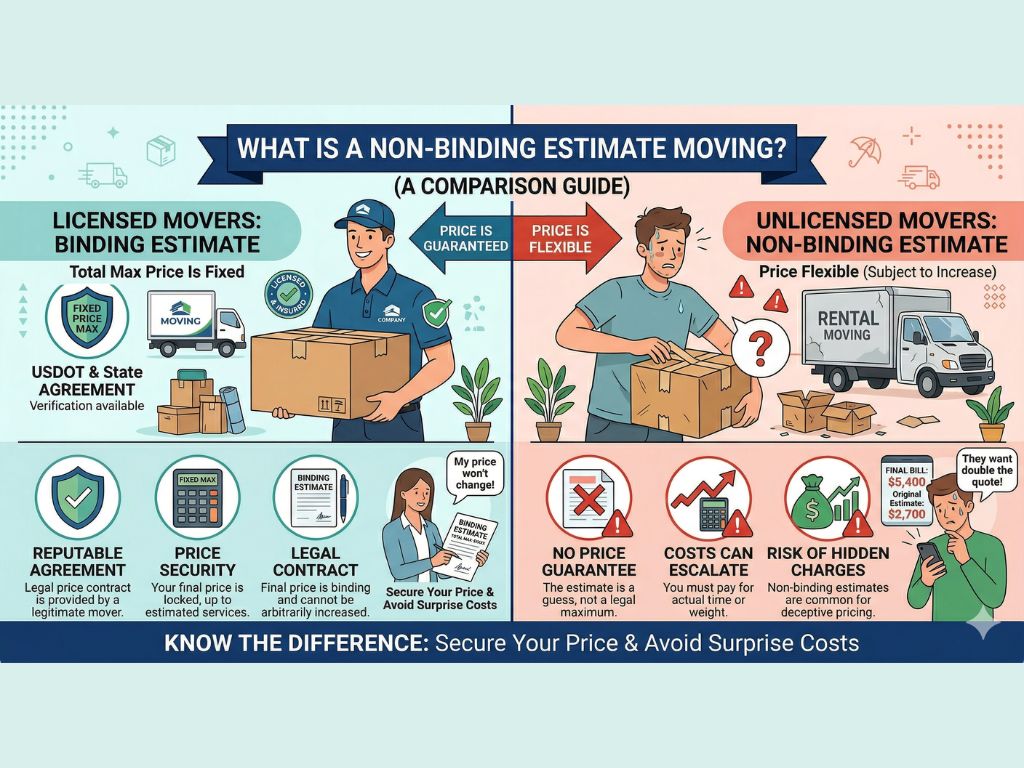
Moving can be a stressful and expensive process. One of the first steps is obtaining estimates from various moving companies. Understanding the different types of estimates is crucial to avoid unexpected costs and ensure a smooth move. This article focuses on non-binding moving estimates, explaining what they are, how they work, their pros and cons, and how they differ from other types of estimates.
What is a Non-Binding Moving Estimate?
A non-binding moving estimate is an initial quote provided by a moving company that is not guaranteed. It is an approximation of the total cost of your move based on the information you provide about the items you plan to move, the distance of the move, and any additional services you require. However, the final cost can change based on the actual weight and volume of your belongings, as well as any unforeseen circumstances that arise during the move.
Think of it as an educated guess. The moving company assesses your needs and gives you a price range they anticipate the move will cost. This estimate is based on factors like:
- Inventory of items to be moved
- Distance between origin and destination
- Accessibility of both locations (stairs, elevators, etc.)
- Any extra services, such as packing, unpacking, or furniture disassembly/reassembly
It's important to remember that a non-binding estimate serves as a starting point for negotiations and planning. It's not a contract guaranteeing a specific price.
How Non-Binding Estimates Work
The process of obtaining a non-binding moving estimate typically involves the following steps:
- Initial Contact: You contact a moving company and provide them with basic information about your move, such as the origin and destination addresses, the approximate date of your move, and a general idea of the size of your household.
- Inventory: The moving company will ask you for a detailed inventory of the items you plan to move. This can be done through a phone call, an online form, or, preferably, an in-home estimate. The more accurate your inventory, the more accurate the initial estimate will be.
- Estimate Calculation: Based on the inventory and other factors, the moving company will calculate an estimated cost for the move. This estimate will typically include charges for transportation, labor, packing materials, and any additional services requested.
- Estimate Delivery: The moving company will provide you with a written estimate outlining the estimated costs and the terms and conditions of the move. Make sure to read this document carefully before agreeing to anything.
- The Actual Move: On moving day, the movers will load your belongings onto the truck. The actual weight and volume of your items will be determined at this point.
- Final Cost Calculation: After the move, the moving company will calculate the final cost based on the actual weight and volume of your belongings and any additional services performed. This final cost may be higher or lower than the initial estimate.
Factors Affecting the Final Cost with a Non-Binding Estimate
Several factors can cause the final cost of your move to differ from the non-binding estimate. These include:
- Weight and Volume Discrepancies: The most common reason for a difference between the estimate and the final cost is an inaccurate estimate of the weight or volume of your belongings. If you underestimate the amount of stuff you have, the final cost will likely be higher.
- Additional Services: If you request additional services that were not included in the initial estimate, such as packing, unpacking, or furniture disassembly/reassembly, the final cost will increase.
- Unforeseen Circumstances: Unexpected events, such as traffic delays, weather conditions, or access difficulties at either the origin or destination, can increase the labor costs and, therefore, the final cost of the move.
- Long Carry Fees: If the movers have to carry your belongings a long distance from the truck to your home (e.g., due to parking restrictions or apartment building layouts), you may be charged a long carry fee.
- Stair Carry Fees: Moving items up or down stairs can be more time-consuming and labor-intensive, resulting in stair carry fees.
- Shuttle Service: If the moving truck cannot access your home directly and a smaller shuttle truck is needed to transport your belongings, you will be charged for this additional service.
Pros and Cons of Non-Binding Moving Estimates
Like any type of moving estimate, non-binding estimates have their advantages and disadvantages.
Pros:
- Flexibility: Non-binding estimates allow for adjustments based on the actual weight and volume of your belongings. This can be beneficial if you are unsure of the exact amount of stuff you have.
- Lower Initial Cost: Non-binding estimates may appear lower than binding estimates, as they are often based on a more optimistic assessment of the move.
- Opportunity for Negotiation: You can negotiate the final cost with the moving company if it exceeds the estimate by more than 10% (as per federal regulations).
Cons:
- Uncertainty: The final cost can be significantly higher than the initial estimate, making it difficult to budget accurately for your move.
- Potential for Hidden Fees: Some moving companies may use non-binding estimates to lure customers in and then add hidden fees or charges to the final bill.
- Disputes: Disagreements over the final cost are common with non-binding estimates, leading to potential disputes with the moving company.
Non-Binding vs. Binding vs. "Not-to-Exceed" Estimates
It's essential to understand the differences between non-binding, binding, and "not-to-exceed" estimates to choose the option that best suits your needs and budget.
Binding Estimate:
A binding estimate is a guaranteed price for your move based on a detailed inventory of your belongings. The moving company cannot charge you more than the agreed-upon price, even if the actual weight or volume of your items is higher than estimated. However, if you add items to the move that were not included in the initial inventory, the moving company can charge you extra for those items. A binding estimate offers predictability but requires a very accurate inventory beforehand.
"Not-to-Exceed" Estimate:
A "not-to-exceed" estimate is a hybrid approach. The moving company provides an estimate, but the final cost will not exceed that amount. However, if the actual weight or volume of your belongings is less than estimated, you will pay the lower price. This type of estimate offers some price protection while still allowing you to benefit if your move ends up being smaller than anticipated. It's often considered the best of both worlds, but it's not as commonly offered by moving companies.
To ensure you're getting the best deal, it's crucial to understand how to choose a reputable moving company. This involves checking their licensing, insurance, and customer reviews.
Protecting Yourself with a Non-Binding Estimate
While non-binding estimates come with inherent risks, there are steps you can take to protect yourself and minimize the chances of being overcharged:
- Get Multiple Estimates: Obtain estimates from at least three different moving companies to compare prices and services.
- Request In-Home Estimates: Whenever possible, request an in-home estimate from each moving company. This allows the movers to see your belongings in person and provide a more accurate estimate.
- Provide an Accurate Inventory: Be as thorough and accurate as possible when providing the moving company with an inventory of your belongings. Don't underestimate the amount of stuff you have.
- Read the Fine Print: Carefully read the terms and conditions of the estimate before signing anything. Pay attention to any clauses regarding additional charges, liability, and dispute resolution.
- Ask Questions: Don't hesitate to ask the moving company questions about the estimate, their pricing policies, and their procedures for handling disputes.
- Document Everything: Keep copies of all communication with the moving company, including emails, phone calls, and the estimate itself. Take photos of your belongings before the move to document their condition.
- Be Present During the Weighing: If possible, be present when the moving truck is weighed to ensure that the weight is accurate.
- Understand Your Rights: Familiarize yourself with your rights as a consumer under federal regulations governing interstate moving.
Federal Regulations and Non-Binding Estimates
The Federal Motor Carrier Safety Administration (FMCSA) regulates interstate moving companies and has established rules to protect consumers. These regulations include:
- Estimate Requirements: Moving companies are required to provide written estimates that clearly outline the estimated costs, the terms and conditions of the move, and the mover's liability for loss or damage.
- Weight Verification: Moving companies must weigh the moving truck before and after loading your belongings to determine the actual weight of the shipment. You have the right to be present during the weighing.
- Dispute Resolution: The FMCSA provides a process for resolving disputes between consumers and moving companies.
- 110% Rule: For non-binding estimates, the moving company cannot require you to pay more than 110% of the original estimate at the time of delivery. You have 30 days to pay any remaining balance.
Knowing these regulations can help you navigate the moving process with more confidence. You can also use a moving cost calculator to get a general idea of what your move might cost.
When to Choose a Non-Binding Estimate
A non-binding estimate might be suitable in certain situations:
- Uncertainty about Inventory: If you are still in the process of decluttering or downsizing and are unsure of the exact amount of stuff you will be moving, a non-binding estimate can provide a starting point.
- Local Moves: For local moves where the cost is primarily based on hourly labor, a non-binding estimate may be sufficient.
- Negotiating Power: If you are a skilled negotiator and confident in your ability to challenge any unexpected charges, a non-binding estimate may allow you to potentially save money.
Alternatives to Non-Binding Estimates
If you're uncomfortable with the uncertainty of a non-binding estimate, consider these alternatives:
- Binding Estimate: Get a binding estimate for a guaranteed price, ensuring no surprises on moving day. This requires a detailed and accurate inventory.
- "Not-to-Exceed" Estimate: Opt for a "not-to-exceed" estimate for price protection and the potential to pay less if your move is smaller than anticipated.
- Flat-Rate Pricing: Some moving companies offer flat-rate pricing for certain types of moves, such as small apartment moves or moves within the same city.
Minimizing Risks with Non-Binding Estimates
Even if you choose a non-binding estimate, proactive steps can minimize potential cost overruns:
- Declutter Beforehand: The less you move, the lower the cost. Decluttering significantly reduces weight and volume.
- Pack Smart: Proper packing protects your belongings and can sometimes reduce the overall volume. Use appropriately sized boxes and pack efficiently.
- Disassemble Furniture: Disassembling furniture makes it easier to move and can reduce the overall space it occupies in the truck.
- Be Organized: A well-organized move reduces the time it takes to load and unload, potentially lowering labor costs.
By taking these precautions, you can make your move more predictable and affordable, regardless of the type of estimate you choose.
Conclusion
Understanding the intricacies of non-binding moving estimates is crucial for a smooth and cost-effective move. While they offer flexibility, they also come with the risk of unexpected charges. By carefully researching moving companies, obtaining multiple estimates, providing an accurate inventory, and understanding your rights, you can protect yourself from potential overcharges and ensure a positive moving experience. Remember to weigh the pros and cons of non-binding estimates against other options, such as binding and "not-to-exceed" estimates, to choose the best fit for your individual needs and circumstances. Remember to consult resources such as a comprehensive moving checklist to keep yourself organized during the moving process.
Frequently Asked Questions (FAQs)
-
What happens if the final cost exceeds the non-binding estimate by more than 10%?
According to federal regulations, the moving company cannot require you to pay more than 110% of the original estimate at the time of delivery. You have 30 days to pay any remaining balance.
-
Can I refuse to pay the extra charges if I disagree with them?
You can dispute the extra charges, but you are still obligated to pay 110% of the original estimate at the time of delivery. You can then file a complaint with the moving company and, if necessary, with the FMCSA to resolve the dispute.
-
How can I ensure that the moving company accurately weighs my belongings?
You have the right to be present during the weighing of the moving truck. Ask the moving company for the weight tickets and verify that the weights are accurate. If you suspect that the weights are incorrect, you can request a re-weighing at your own expense.
-
What should I do if I discover damage to my belongings after the move?
Notify the moving company in writing as soon as possible after discovering the damage. Take photos of the damaged items and keep all packing materials. The moving company will likely have a claims process that you will need to follow.
-
Are moving companies required to offer different types of estimates?
While not explicitly required to offer all types, reputable moving companies typically provide multiple options, including non-binding, binding, and sometimes "not-to-exceed" estimates, to cater to different customer needs and preferences.
-
What is the best way to prepare for an in-home moving estimate?
Before the estimator arrives, create a detailed inventory of everything you plan to move. This will help them provide a more accurate estimate. Also, be prepared to discuss any specific needs or concerns you have about the move.
-
How do I file a complaint against a moving company?
You can file a complaint with the FMCSA through their website or by calling their toll-free number. You can also file a complaint with the Better Business Bureau or your state's consumer protection agency. Remember to gather all relevant documentation before filing your complaint.
Categories
- Long Distance Moving159
- Local Moving120
- Commercial Moving40
- Residential Moving34
- Last – Minute Moving25
- Furniture Moving11
- Moving Tips & Lifestyle11
- Moving Tips & How-To Guides8
- Moving services7
- Moving Costs & Budgeting6
- Moving Cost5
- Moving Cost Calculator5
- Moving Tips5
- Moving Guides5
- Moving Container4
- moving tips4
- Moving companies4
- state to state movers4
- Piano Moving3
- Car Transportation3
- Truck Rental3
- Local Move3
- best moving rates3
- cheap moving companies3
- affordable moving companies3
- full-service movers3
- Moving3
- Long distance moving3
- Long-Distance Moving3
- Moving Cost Guides3
- Moving Tips & Planning3
- long distance moving3
- Junk Removal2
- Senior Moving2
- Senior Relocation Moving Companies2
- Moving Tools2
- Moving Estimates2
- interstate moving2
- College Moving2
- Dorm Moving2
- Tips for moving2
- cross-country move2
- International moving2
- Household moving2
- Relocation Guide2
- Moving Tips & State Guides2
- Heavy Equipment1
- Senior Moving Services1
- office moving1
- office relocation1
- employee relocation1
- Car Transport1
- Vehicle Shipping1
- Car Shipping Services1
- Artificial Intelligence1
- Office Moving Services1
- Commercial Moving Companies1
- Corporate Moving Services1
- Corporate Movers1
- full-service moving companies1
- sustainable moving companies1
- green movers1
- Moving in US1
- Best places to move in 20251
- 2025 moving1
- Full-Service Moving Companies1
- College moving services1
- Moving to College1
- Moving Season1
- Spring Moving1
- donate1
- sell1
- Movers in California1
- Movers in Studio City1
- Moving to California1
- Laws about Moving into California1
- Moving Laws1
- House moving1
- packing1
- cheap moving ways1
- Moving guide1
- moving across countries1
- international relocation program1
- move out cleaning1
- right packing supplies1
- pack while moving1
- Apartment moving1
- PODS1
- moving out1
- state to state move1
- California movers1
- Truck Rental1
- US Territory Relocation1
- International Moving1
- Shipping & Moving Tips1
- Moving Budget Guide1
- Moving Tools & Equipment Guides1
- Moving Services & Options1
- Moving Tips & How-To Guides1
- Moving Day & Settling In1
- Mobile Home Moving1
- Moving Guide & Tips1
- Moving Tips & State Comparisons1
- Moving Tips & City Guides1
- Moving Tips & Cost Guides1
- Long-Distance Moving Tips1
- Moving Tips & Financial Planning1
- Moving Tips & Home Preparation1
- Vehicle Shipping & Auto Transport1
- Marketing & Lead Generation1
- International Moving Guides1
- Moving Costs1
- San Francisco Moving Guide1
- NYC Moving1
- Local Movers1
- Budget Moving1
- Student Moving1
- Affordable Moving1
- Specialty Moving Guides1
- Local & Long-Distance Moving1
- Boston Moving Guide1
- Europe Relocation Guide1
- Moving Costs & Specialty Moving1
- Cost of Living1
- Relocation1
- International Moving1
- Lifestyle & Relocation1
- State Guides1
- Home Buying Guide1
- Moving Timeline1
- Real Estate Tips1
- Appliance Moving1
- Packing & Preparation1
- Interstate Relocation1
- City-to-City Moving Guide1
- Technology for Movers1
- Moving Reviews1
- Moving Costs & Storage1
- Moving Tips & Equipment Guides1
- Moving Guides & Cost Insights1
- Moving Supplies1
- Packing Tips1
- Home Moving1
- Relocation Tips1
- State Moving Guides1
- New Home Guide1
- Relocation Advice1




 Chat with us on WhatsApp!


 BBB A+ Rated
 Great! We serve your area
 Licensed & Insured
 Takes 60 seconds

 Discount expires in
 Limited Time: Only 3 premium movers available in your area


 Your information is 100% secure